1.Introduction
This is the manual for the integration between Magento and Exact Online.
The integration is working for these versions of Magento: FAQ - Magento versions. The integration is a basic integration. Magento has many options in the standard version that the integration does not support. In particular, these are:
- Reading shipping addresses. We do have an option for this, but it needs to be programmed on the Magento webshop side.
- Reading payment costs. We do have an option for this, but it needs to be programmed on the Magento webshop side.
- Adding discounts excl. VAT. The integration does not support this.
- Adding credit amounts - adjustments - in credit invoices. The integration cannot process this because the VAT information is missing.
- In some situations, the VAT of free items cannot be determined correctly.
- In some situations, the VAT percentage does not come through correctly from the Magento webshop. This often happens with smaller amounts and/or large quantities. Magento webshops pass on amounts in 2 decimals, not 4. This causes rounding differences. These invoices will have to be entered manually in Exact Online.
- We will supplement this list if we notice that more items are missing.
This integration does not replace the work of an accountant. It saves time because you no longer have to retype documents. The accountant is still needed for advice, expertise, and control.
Tip: Other customers using this integration found the tips in the FAQ for Magento and in the FAQ for Exact Online.
Read more Introduction .... Read less Introduction ....Installing the integration starts with signing up for a trial period, via our integrations page. After registration, you will receive an email containing an installation URL and login details. With this installation URL, you start the installation of the integration.
The installation is complete when both connection dots are green, and the settings in the Configuration tab have been entered and saved.
There is a trial period of 30 days.
If you want to install another integration, you can do so in the same way. Make sure you are logged out of the integration dashboard and preferably start the new installation in an incognito browser.
At the end of the trial or subscription period, the integration will not be automatically renewed. You will receive an offer for a one-year subscription or renewal by email at the end of this period. You can confirm the renewal by using the payment link in that email. Do you want to terminate the integration in the meantime? Please send us an email with the request and the license key. We can only stop integrations for you as of the current date, not on a future date.
Are you switching to another web shop/accounting system and do you want to re-establish a connection? In this faq we explain how to do this.
We advise you to deactivate the OAuth keys of the integration in your Magento webshop when uninstalling the integration.
2.How the integration works
Please note: The integration always creates the invoice, order or sales booking with status Draft. This is because deleting or adjusting is otherwise very difficult in Exact Online.
Invoices are retrieved from the Magento webshop once per hour. This integration processes Magento invoices, not Magento orders. The integration works for both Magento 1.9 and Magento 2.x webshops, starting from Magento 2.1. Therefore, we do not support Magento 2.0.
Read more How the integration works .... Read less How the integration works ....
At the start of processing an invoice, we perform a number of checks on the Magento invoice:
- It is checked whether the total of the Magento invoice is equal to the sum of the amounts in the invoice lines.
- If the invoice is an ICP invoice, the VAT number is checked.
- It is checked whether a corresponding VAT code exists in Exact Online for the VAT in each line.
- It is checked whether the invoice has not already been processed.
Processing a Magento invoice to Exact Online takes place in three steps:
- It is checked if the customer already exists in Exact Online. If not, the customer is created. Matching is based on the email address.
- When processing to Exact Online orders or invoices, a check is performed to see if the products from the Magento invoice are already present in Exact Online. Missing products are created.
- The Exact Online invoice, order or sales booking is created and added.
After the invoice has been forwarded and a success message from Exact Online has been received, the invoice is marked as completed. The Magento invoice appears in the Report tab on the dashboard.
If Exact Online returns an error while processing the invoice, the invoice appears in the Errors tab on the dashboard. Via the yellow button More info more information about the problem can be found. Via the red button Report problem can the invoice with all necessary information easily be submitted to us after you have tried to resolve the problem yourself. If the problem is solved, in some cases the invoices can be processed again with the blue Process button.
Data
Information about the data that is processed can be found in the section Day-to-day: To Exact Online later in the manual.
3.Required: Magento keys - only Magento 1.x
This step is only necessary for Magento 1.x. If you have a Magento 2.x webshop, you can skip this chapter!
3.1 Install extension
Installing and configuring the extension for Magento 1.x consists of the following steps:
First, check if your Magento webshop environment allows the use of the REST API. This check consists of the following steps. We use www.jouwwebwinkel.nl as the URL of your webshop.
(i) Is the REST API accessible? You can test this with the url http://www.jouwwebwinkel.nl/api/rest/products. Do you see a 403 appear on your screen? Fine. But …
(ii) … do you see a 404-screen?
Then the URL is redirected to an error page. This could be a problem with the .htaccess file. The line RewriteRule ^api/rest api.php?type=rest [QSA,L] must be present in this file. If not, you need to add it.
The problem could also be caused by a setting in the Apache web server. See this link for more information: http://magento.stackexchange.com/questions/29936/rest-api-returns-404.
(iii) Does the username you used to create the OAUTH keys have admin rights? That is actually necessary, otherwise the data cannot be retrieved from the webshop.
(iv) Do you use php-fpm fastcgi in the hosting environment? In that case, the authorization keys may not be transmitted correctly. This link contains more information: http://www.magentogeek.com/magento-rest-api-solution-for-400-bad-request/. This applies, among other things, to webshops hosted at byte.nl - shared hosting. They have a good explanation to solve this.
(v) In all cases: Contact us if you can't figure it out. We sometimes see details in our log files that might help you resolve the problems.
1. Turn off caching in your webshop. You can do this via System > Cache Management. After installing the extension, you can turn caching back on.
2. Install extension. Unzip the file and install the files under your Magento root. You can see from the structure of the zip file where to place which files. No files will be overwritten.
3. Define the REST Role. You first define a so-called Role that can read the invoice details, including tax rates and payment methods, from your webshop. To do this, go to System > Web Services > REST Roles. To use the extension, you need to create a Role of type Administrator. You create this by clicking Add Admin Role. If you already have one, you can reuse that Role.
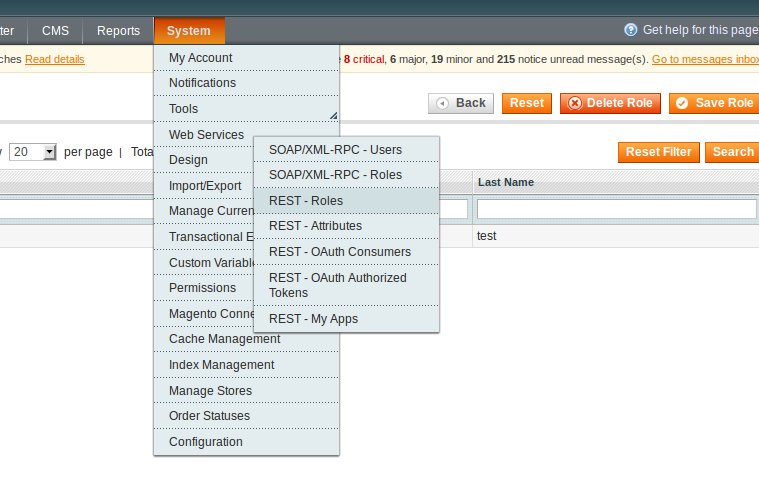
On the left side of the screen is a screen titled Role Information. Click on the sub-menu link Role API Resources. You will see the option REST API Calls to read invoices appear. Check all the boxes under this option and save the details.

You have now configured the integration to have the right to read the invoices, tax rates, and payment methods entities from Magento, but you have not yet specified which data it is allowed to retrieve per entity.
4. Assign the fields that can be read. Go to System > Web Services > REST Attributes. Open the User Type Admin. Here, you will see the option REST API Calls to read invoices appear again. Check all options again and save the details.

5. Link the administrator to the REST role. Finally, you need to assign the administrator to the REST role. Go to System > Permissions > Users. Click on the administrator of the webshop. Go to REST Role, the bottom option in the menu on the left. Assign the administrator of the webshop to the Administrator REST Role.

The steps for creating a Magento consumer key and consumer secret are as follows:
1. Log in as admin to your Magento 1.x webshop.
2. Go to System > Web Services > REST OAuth Consumers.
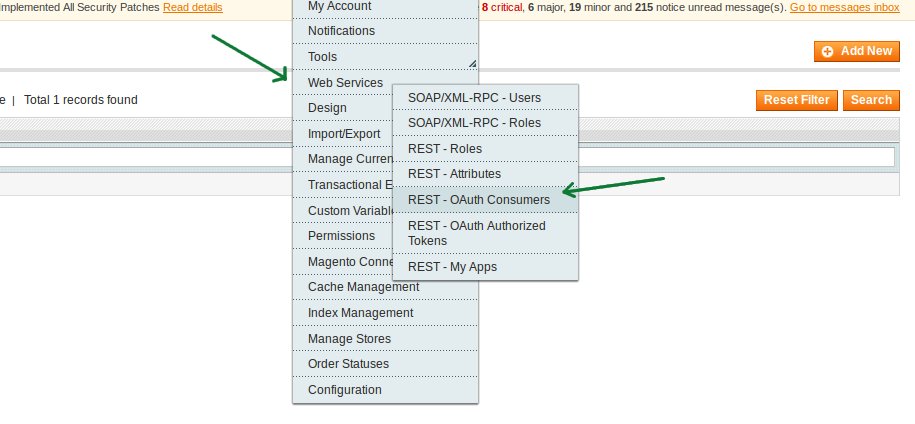
3. Click Add new to create the Magento keys. The key and secret are already filled in. Enter the name for the connection and the callback URL yourself. The value of the callback URL must be: https://interface.cloudinvoice.company/api/v1/servlet/magento/callback.php

4. Enter your administrator password. Click Save. You will enter the key and secret from this screen in a later chapter in the Consumerkey and Consumersecret fields of the connection settings screen.
4.Required: Magento after version 2.1
Magento webshops up to and including version 2.4.3 should follow the steps below to establish a connection with the webshop. For Magento webshops from version 2.4.4 onwards, we recommend creating an integration as explained below, but without a callback. If you contact us afterwards, we will ensure that you can enter the client ID / client secret / access token and token secret to establish the connection with the Magento webshop.
Please note: This is a standard integration without customization options. This means that the integration does not support all extensions in the webshop. It can also be difficult to connect the webshop due to a specific hosting configuration, for example, because of a modified .htaccess file, complex redirects, or a firewall. If you encounter these problems, it is often necessary to engage a Magento expert.
Installing and configuring the extension for Magento 2.x consists of the following steps:
1. Configuration. There are two Magento tabs you need to fill in. For the first one, we come up with a recognizable name and enter the Callback URL (https://interface.cloudinvoice.company/api/v1/servlet/magento2/callback.php?cikey=YOURLICENSEKEY), the Identity link URL (https://interface.cloudinvoice.company/api/v1/view/cloudinvoice/authenticate.php), and your password. YOURLICENSEKEY must be replaced with the license key from the email. It is always smart to save in between (top right). After that, we move on to the second tab, API.
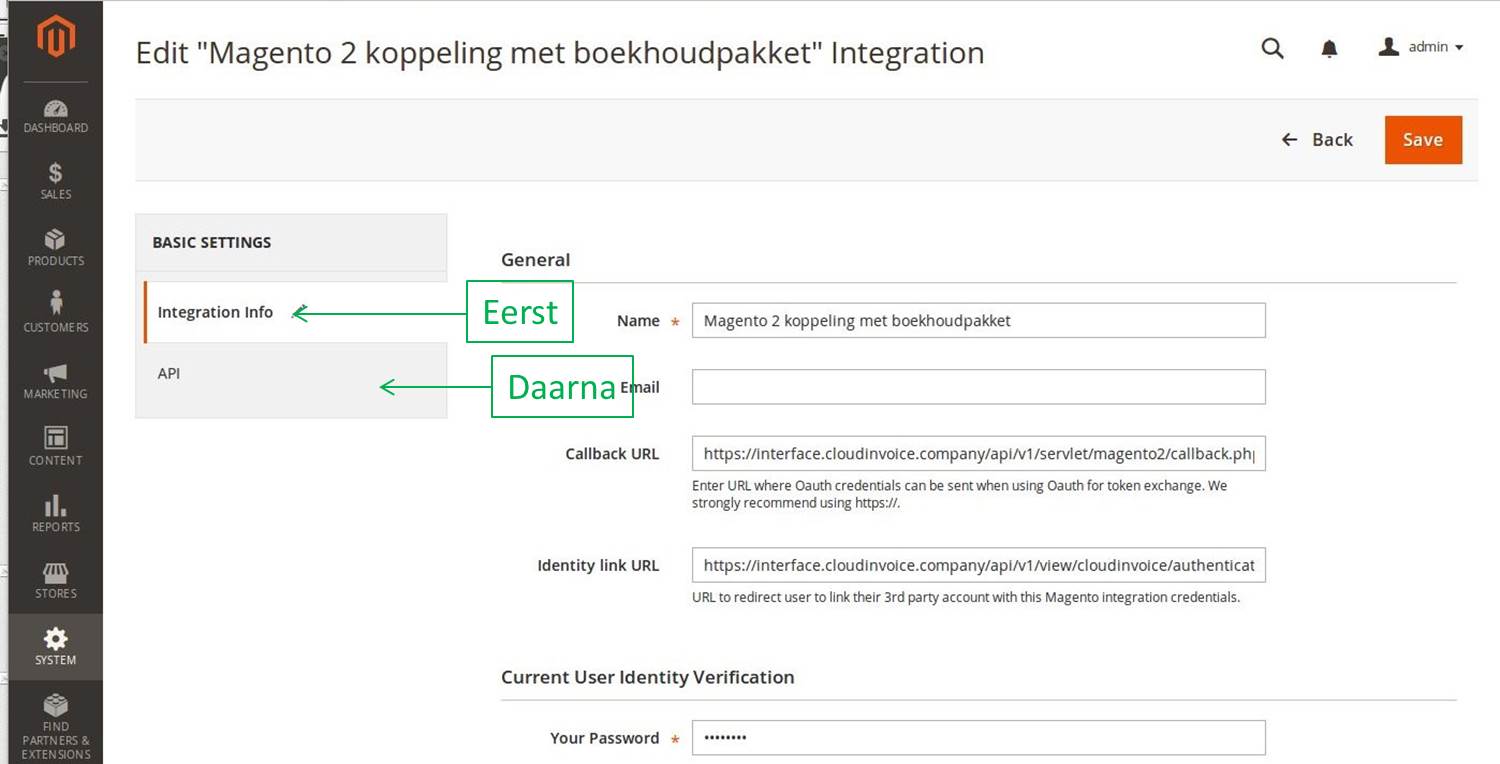
You are now going to assign the permissions: which data from the webshop is the integration allowed to use? The image explicitly indicates which resources you need to check. Then click SAVE in the top right.
 2. Activating the extension. You are now going to activate the extension. First, click on ACTIVATE.
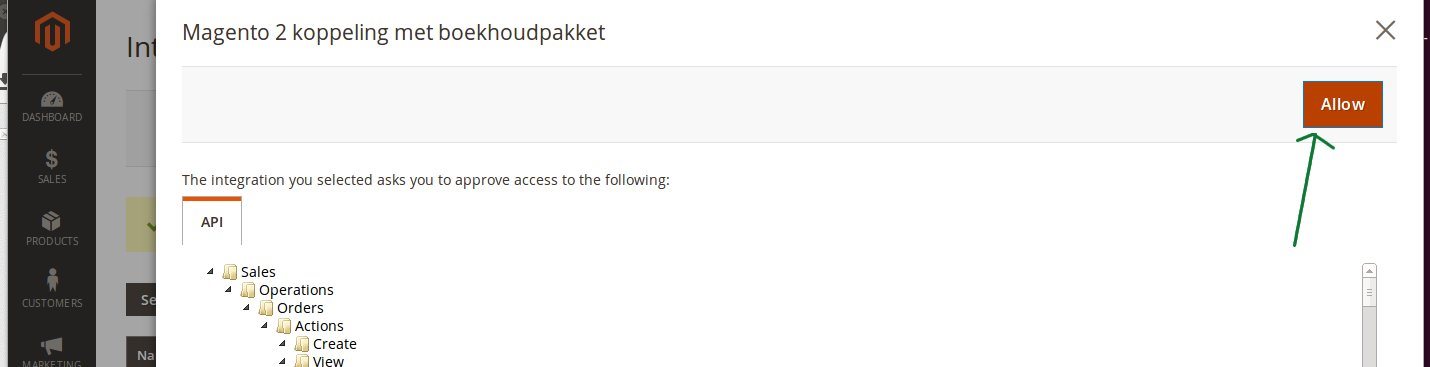
 You must grant permission to do so using the ALLOW button in the top right of the next screen.
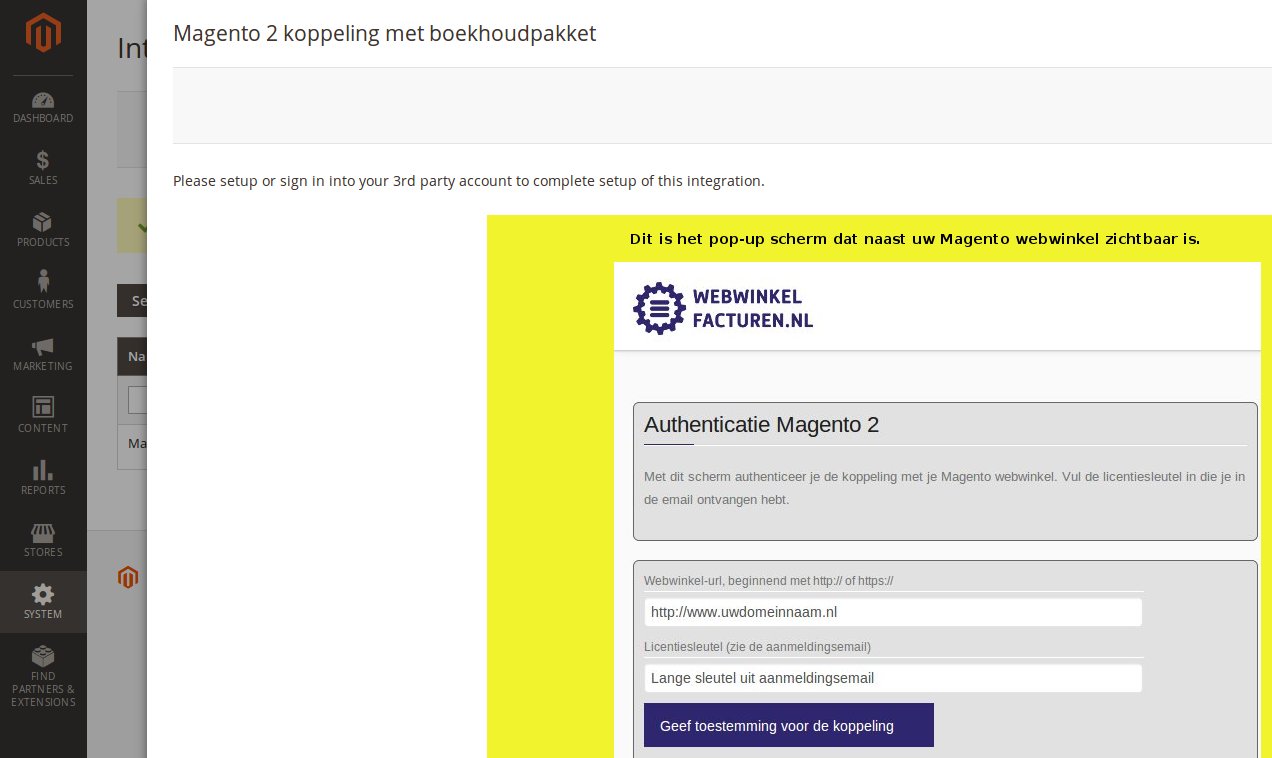
 And now you finally understand why Magento 2 is called 'Magento 2': two windows open! On the first window (so outside your Magento store):

In this separate window, enter your webshop domain name and the connection key you received by email upon registration. If you then click the Consent to connect button, you will see the activation take place in the other screen (of your Magento store).
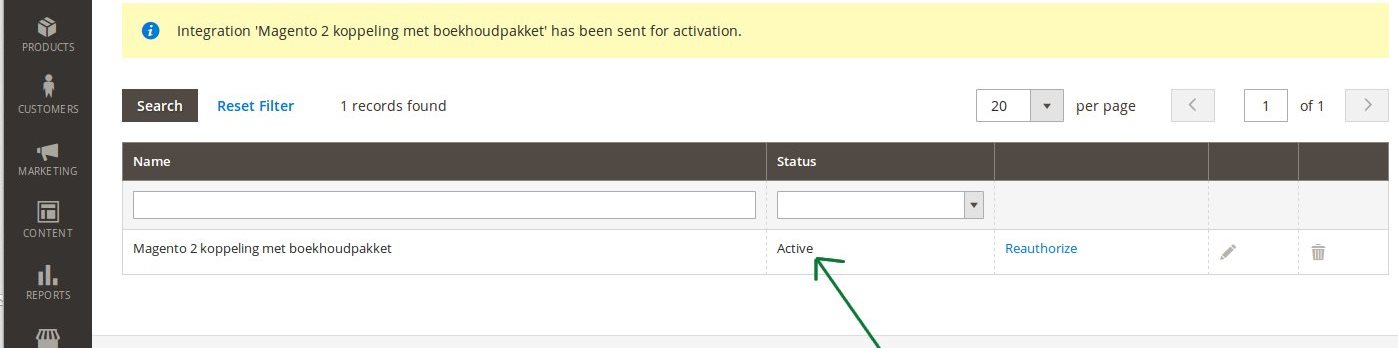
 The extension is now fully activated. To be sure, you can check the status of your integration on the Integration screen within your Magento webshop. The status should now be ACTIVE.
 You have now completed the preparations in your Magento 2.x store.
5.Preparation Exact Online
To integrate with Exact Online, a dedicated username and password are required to log in. The integration must be established using this username and password. A separate username is required for each connection. Therefore, if you have two or more integrations with Exact Online running with us, you will need two or more Exact Online usernames. See this faq more information.
Using an accountancy username/password grants the integration access to all records under the accountant's responsibility. This is highly undesirable from a security standpoint and violates GDPR regulations. See this faq for more information.
6.Installation
Installing the integration starts with signing up for a trial period, via our integrations page. After registering, you'll receive an email with an installation URL and login details. Use this installation URL to start the integration installation.
Activating the integration consists of three steps:
1. Establishing the connection with the Magento webshop. For Magento 2.x webshops, you have already done this in the previous step. For Magento 1.9 webshops, you need to fill in additional details here.
2. Establishing the connection with Exact Online. This authorizes the integration to write transactions to your Exact Online administration and read information.
3. Configuring additional data, such as the VAT settings. Please note: The integration uses the amounts from the webshop to calculate the VAT percentages. Ensure that rounding differences do not cause problems with the VAT percentages.
Authentication Magento webshop:
This step only needs to be performed for Magento 1.9 webshops. For Magento 2.x webshops, the authentication has already been done in the previous step. Authenticating the Magento 1.9 webshop is done as follows:
- First you fill in the admin URL of the webshop with the consumerkey and consumersecret from the previous step.
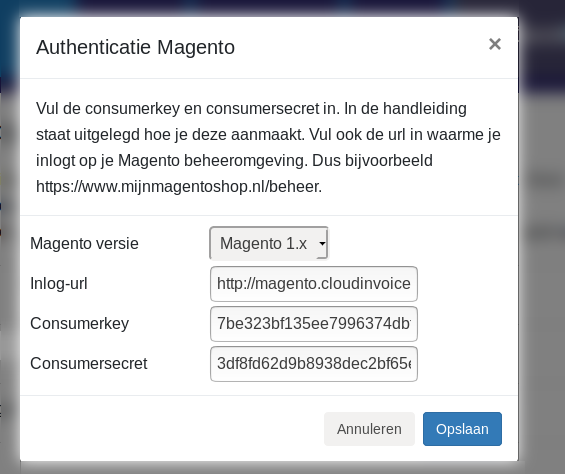
- Then you click the yellow Connect button to give the integration the correct authorization. Only after performing these two steps is a valid connection with the Magento webshop established. You can see this because the indicator will be green.
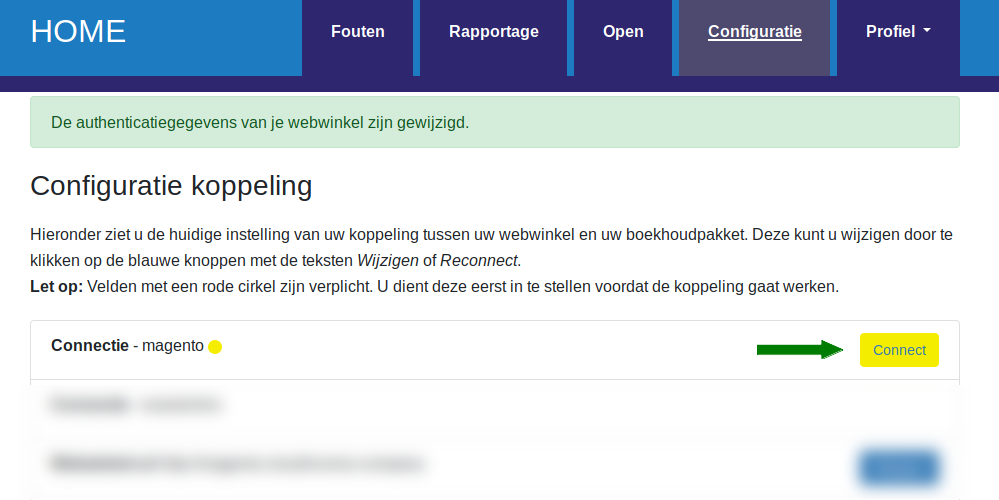
Authentication with Exact Online is via OAuth. Ensure you are logged out of Exact Online before starting the connection. Now click the red Connect button. A login screen for your Exact Online account will appear automatically. Once you log in, you will see a screen asking if you allow the connection. Upon confirmation, the connection with Exact Online will be established.
If you wish to re-establish the connection at a later time - for example, because you want to connect via a different Exact Online user - you can always do so by clicking the Connect button.
Invoices from Magento can be processed to Exact Online orders, invoices or sales entries. The desired option can be selected via the contract settings.
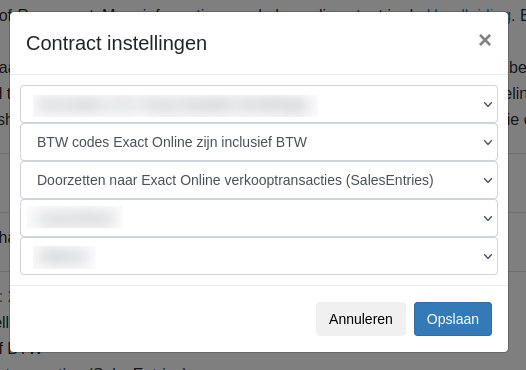
Exact Online Division code
It is important that after establishing the connection with Exact Online, you first set the division code of your Exact Online administration. As long as the division code is unknown, data from your Exact Online administration—such as VAT codes, ledger accounts, journals, and payment conditions, which depend on this division code—cannot be retrieved. After setting the division code, it may be useful to retrieve the data from Exact Online again. You can do this via the two arrows next to the copy button.
Exact Online Journal
A journal must be set for the entries. A sales journal must be set here for creating sales entries. For Dutch administrations, this is usually journal 70 and for Belgian administrations 700. A cash journal must be set for the revenue entries. For Dutch administrations, this is usually journal 10.
Payment condition Exact Online
When creating new debtors, the integration will set a payment condition. The payment condition that the integration adds to new debtors can be selected via the dropdown. This payment condition is not added if it concerns an existing debtor.

When configuring the VAT rates and general ledger accounts, a link is created between the VAT rates in webshop and the VAT codes and revenue accounts in Exact Online. You can always make changes by clicking the blue 'Edit' button and selecting an option from the drop-down menus.
By default, all EU countries are shown in the list. You only need to configure the countries you sell to, and - if applicable - ICP and International. The integration shows the standard VAT rates for Europe. You can adjust the VAT percentage with which you sell - left column. For example: By default, sales to Germany are set to 21%, but if you sell in the webshop with 19%, you can adjust that in the left column. Intra-Community (ICP) and international deliveries
The Intra-Community supplies / ICP option is intended for business-to-business deliveries within the EU. These sales are invoiced with 0% VAT. A VAT number from the customer is required. The International option applies to deliveries outside the EU. For these sales, the integration expects 0% VAT; otherwise, the sales cannot be processed. Separate VAT codes and general ledger accounts can be configured for both ICP and international deliveries.
The Exact Online VAT codes are shown depending on the contract settings. If Exact Online excl is selected, only the Exact Online VAT codes excl will be shown. If Exact Online incl is selected, only the Exact Online VAT codes incl will be shown. Only the Profit and Loss ledger accounts on the credit side are shown.
Once the VAT settings have been configured and saved, you will always see the set VAT rates. If you want to start over, you can use the grey button 'Remove VAT settings'. Your current settings will then be deleted.

You can create a link here between the payment methods in the webshop and a fixed debtor in your Exact Online administration. Invoices with a payment method from the list will then always be posted to this debtor. In that case, no new debtors will be created.
Note: It is not possible to set fixed debtors for ICP invoices. For an ICP invoice, a valid VAT number must be transmitted. Therefore, a debtor will always be created in Exact Online for an ICP invoice.
Please note: The list of debtors only includes the Exact Online debtors whose name contains a specific substring. See this FAQ for more information.

7.Day-to-day: From Magento
In this section, we show how we retrieve the invoices from the webshop.
Once an invoice has been processed, it cannot be processed again. An invoice that is modified in the webshop after it has been processed will not be adjusted in Exact Online.
VAT numbers For business orders within the EU, outside the Netherlands, a VAT number is mandatory. The integration checks for this and also verifies that the VAT number is a valid VAT number.
VAT calculation: The integration always uses the prices in the [base_] fields, such as [base_grand_total] and [base_row_total].
The VAT amount in the invoice lines is determined as follows:
VAT amount = ['base_row_total_incl_tax'] - ['base_row_total']
The VAT percentage is determined as follows:
VAT amount/ ['base_row_total']
If the amount excl. VAT is 0, the VAT percentage defaults to 21%. Unfortunately, this cannot be adjusted.
Based on the VAT percentage, the VAT code and the general ledger account in Exact Online are determined. We notice that some Magento webshops make their own corrections to the VAT in their invoices. The VAT then does not exactly match the VAT of the products. This results in incorrect VAT percentages, such as 8% instead of 9% and 22% instead of 21%. The integration cannot correct this and will give an error message if 8% and 22% do not appear in the webshop's VAT settings. We generally see this problem occur when using small amounts. Unfortunately, the integration does not have an adequate solution for this.
Field-level specification invoices
| Below is a specification at the field level for retrieving invoices from Magento 2.x webshops. | |
| Name field | Values from Magento order |
| Factor for multiplying amounts | In the Magento credit invoices, the amounts are listed as positive amounts. This is because debit invoices and credit invoices are separate entities. In Magento, you therefore have two types of invoices, debit and credit, and both types have a positive amount. Therefore, the integration uses a factor = 1 for debit invoices and a factor = -1 for credit invoices. |
| Invoice-identifier | [entity_id] Please note, to keep those IDs unique between debit and credit invoices, the integration places a 1 before the invoice ID of the credit invoice. This is why you see a multiplication by the factor. |
| Invoice number | [increment_id] from the Magento invoice |
| Orderid | [order_id] |
| Order number | [increment_id] from the Magento order. If it is configured for the merchant that the order number is leading, then for the order number a C_ is placed. |
| Affiliate number |
Is determined based on the underlying order
|
| Order-identifier | This is determined based on the URL in the field [order] |
| Invoice date | [created_at] |
| ICP indication |
An invoice is an ICP invoice if:
|
| International indication |
An invoice is an international invoice if:
|
| Payment method |
The payment method is determined as follows based on the field [paymethod]:
|
| Paymentmethod-id | [paymethod_id] |
| Total amounts incl or excl VAT | The amounts in the order can be incl. or excl. VAT. This is determined by the field [taxes_included]. This value is important for determining the Total incl and the Total excl, see below. |
| Total incl | [base_grand_total]. The base_ part ensures that the amount is taken in the webshop's base currency. |
| Total VAT | [base_tax_amount] |
| Total excl | Total incl VAT - Total VAT |
| Shopping cart values | These values are read via [base_subtotal] and [base_subtotal_inc_tax] |
| Name field | Values from Magento order |
| Name product | [name], special characters are removed as much as possible |
| Amount | [qty] |
| Amount incl VAT | [base_row_total_incl_tax]; for the unit amount we divide by the quantity |
| Amount excl VAT | [base_row_total]; for the unit amount we divide by the quantity |
| VAT Amount with discount | [base_row_total_incl_tax] - [base_row_total]; for the unit amount we divide by the quantity |
| VAT percentage |
The VAT percentage is tricky with Magento invoices because the Magento API provides these prices in 2 decimals, which quickly results in a percentage of 20%, 22%, 8% or 10% for small amounts. There is a workaround, but that requires programming work on the side of the Magento webshop.
|
| Discount | [base_discount_amount] for the discount amount incl VAT. For the discount excl VAT [base_discount_amount] - [base_discount_tax_compensation_amount]. |
| Line prices incl and excl discount | These are calculated from the discount and the unit prices. The unit prices are multiplied by the quantity. |
| The shipping costs are added as a separate invoice line | The amounts are determined based on [total_shipping], [shipping_tax_percentage] and [invoice_row_taxes_included] as in other lines. This line is only added for an amount other than 0. |
| The payment costs are added as a separate invoice line | The amounts are determined based on [paymethod_costs], [extra_payment_option_price] and [invoice_row_taxes_included] as in other lines. This line is only added for an amount other than 0. |
| The surcharges are added as separate lines to the invoice | The amounts are determined based on [extra_costs], [credit_point_discount], [invoice_row_taxes_included] as in other lines. The amount is only added for an amount other than 0. This leads to a maximum of 2 extra lines. |
| Accounts and VAT codes from Exact Online | These are determined based on the settings in the integration, the delivery country of the invoice and the VAT percentages. The type for invoice lines is turnover / revenue, for the shipping costs line shipping / shipping costs and payment costs payment / payment costs. |
8.Day-to-day: To Exact Online
Create transactions
When creating sales entries (SalesEntries) in Exact Online, the order number is processed and new debtors are created if they are not yet in Exact Online.
When creating invoices (SalesInvoices) or orders (SalesOrders), the products are also processed if they are not yet present in Exact Online.
Creating new debtors
When processing customer information, a check is first made to see if the customer has been processed before. If so, this Exact Online debtor is used as the debtor for the Exact Online transaction. If the customer is not yet known, they are added to Exact Online. Matching is based on email address.
Please note: The integration only creates debtors. The integration does not modify debtors.
Create products
The following only applies if you process invoices to Exact Online invoices or orders.
New products in Exact Online If the invoices are processed to Exact Online invoices or orders, the integration first checks whether the products from the invoice already exist in Exact Online. The integration then adds missing products to Exact Online. If a product already exists in Exact Online, it is not added again. The rules for matching products between Magento and Exact Online can be found in this FAQ be read.
If invoices are processed to Exact Online orders, new products are automatically linked to a default warehouse. During installation, you can specify the default warehouse. Only one warehouse per integration is possible. Separate dummy products are created for shipping costs, payment costs, and discounts.
Please note: The products are only created in Exact Online. Products in Exact Online are never modified.
Disable ledger mapping: When processing to Exact Online invoices, it is possible to create the invoice without a ledger account. For an explanation see this FAQ. If you wish to use this option, please contact us. For Exact Online orders, the integration never provides a ledger account; the product in Exact Online determines the ledger mapping. For Exact Online sales entries, the integration does not provide products. Therefore, ledger mapping cannot be disabled for this option either.
VAT products When creating new products in Exact Online, the integration uses the VAT percentage from the sales line.
Field-level specification Exact Online

| Name | Example | Note |
| Customer ID | 6a7...e44 | The integration looks up the customer in Exact Online. If the customer is not yet present, the integration creates the customer in Exact Online. Matching is based on email address. |
| Date | 2022-12-05 | The order date |
| Status | 10 | Fixed value, cannot be adjusted |
| Description | 3300 | |
| Your reference | 3300 | The order number from the order in Magento. |
| Payment reference | ||
| WarehouseID | f40...cec | As configured on the dashboard, Configuration tab |
| Shipping address | Identifier | If the shipping address differs from the billing address, the integration creates a separate shipping address in Exact Online. The identifier from the shipping address is provided. |
| Order lines | ||
| Description | Gloss - 5 mtr | Name of the product in the Magento sales line |
| Item | 227...2ed | The identifier of the product from Exact Online |
| Amount | 39 | |
| Price | 5.2000 | Depending on the contract settings. Usually the unit price incl. VAT. |
| VAT code | 2 | As configured on the dashboard, Configuration tab |
| Currency | EUR | The currency of the Magento order. This option is disabled by default. On request, the currency from the sale can be added |

| Name | Example | Note |
| Customer ID | 6a7...e44 | The integration looks up the customer in Exact Online. If the customer is not yet present, the integration creates the customer in Exact Online. Matching is based on email address. |
| Date | 2022-12-11 | The order date |
| Type | 8020 or 8023 | 8020 for regular invoices, 8023 for direct sales invoices. |
| Status | 20 | Draft, the integration only creates invoices with draft status. |
| Journal | 70 | Sales journal |
| Description | ||
| Your reference | 8790 or INV1234 | Default is the order number, invoice number on request. |
| Remark | # | Payment method # |
| Payment reference | ||
| WarehouseID | f40...cec | Only for Direct invoices. This must be requested separately. As configured on the dashboard, Configuration tab |
| Invoice lines | ||
| Description | Guide guidebook | Name of the product in the Magento sales line |
| Item | 227...2ed | The identifier of the product from Exact Online |
| Amount | 1 | |
| Price | 79.99 | Depending on the contract settings. Usually the unit price incl. VAT. |
| VAT code | 4 | As configured on the dashboard, Configuration tab |
| Revenue account | 239...5fa | As configured on the dashboard, Configuration tab. On request, this field can be omitted. Ledger mapping will then be disabled. |

| Name | Example | Note |
| Customer ID | f40...cec | The integration looks up the customer in Exact Online. If the customer is not yet present, the integration creates the customer in Exact Online. Matching is based on email address. |
| Date | 2022-12-12 | The Order Date |
| Journal | 70 | Sales journal |
| Status | 20 | Draft, the integration only creates sales entries with draft status. |
| Description | ||
| Your reference | ||
| Payment reference | ||
| Sales entry lines | ||
| Description | hard floor brush | Name of the product in the Magento sales line |
| Amount | 1 | |
| Price | 5.95 | Depending on the contract settings. Usually the unit price incl. VAT. |
| VAT code | 4 | As configured on the dashboard, Configuration tab |
| Revenue account | 3f3...219 | As configured on the dashboard, Configuration tab. |
9.Support
Read more Support .... Read less Support ....
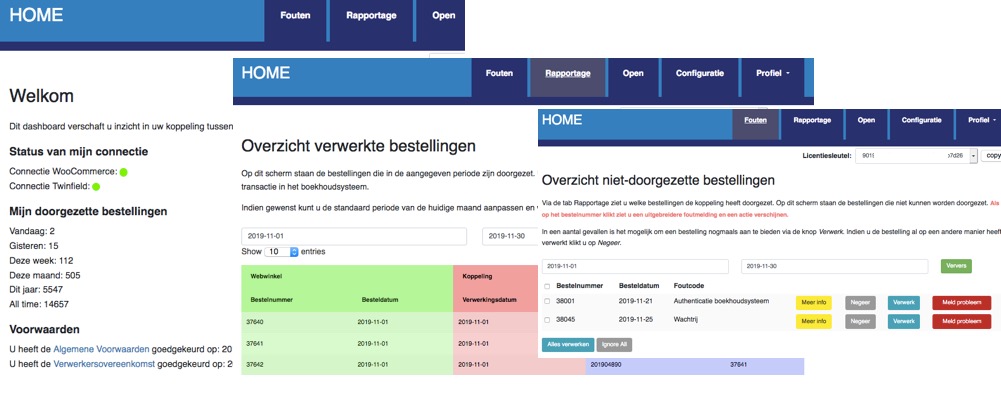
Explanation tabs dashboard
On the Dashboard >> Report you can see which invoices from your Magento webshop, and when, have been transferred to Exact Online.What if invoices are missing in Exact Online
If invoices are missing in Exact Online we recommend following the steps below:- Log in to the dashboard: https://uwkoppeling.webwinkelfacturen.nl. The username and password are included in the registration email.
- Go to the Errors tab and check if invoice is there. You may need to adjust the search period if the
invoice is from a previous month. If you find invoice in this overview:
- Check the error code and verify whether you can resolve it yourself.
- If yes resolve the issue and click the blue Process button to resubmit the invoice.
- If not use the red Report problem button to create a ticket with us.
- Note if there are multiple errors, please create only 1 or 2 tickets. We will automatically see the other issues.
- Go to the Report tab and see if invoice is listed there. If so, you'll often see an identifier for Exact Online (in the purple section of the overview) that you can use to search for invoice.
- Go to the Open tab and check if invoice is there.
- If you cannot resolve the issue, you can always create a ticket via the green Ask us button.