
1.Introduction
This is the manual for the integration between Opencart and Lundify.
- This integration is a financial integration. It is not a logistics integration. It is not suitable for updating customers in Lundify, printing packing slips, or synchronizing products/inventory.
- This integration does not replace the work of an accountant. It saves time because you no longer have to retype documents. The accountant is still needed for advice, expertise, and control.
- Please note: Bjorn Lunden Lundify does not support OSS. This integration is therefore not suitable for OSS. If your webshop falls under OSS regulations, the advice is not to use this integration, or only for non-OSS sales.
Tip: Other customers using this integration found the tips in the FAQ for Opencart and in the FAQ for Lundify.
Installing the integration starts with signing up for a trial period, via our integrations page. After registration, you will receive an email containing an installation URL and login details. With this installation URL, you start the installation of the integration.
The installation is complete when both connection dots are green, and the settings in the Configuration tab have been entered and saved.
There is a trial period of 30 days.
If you want to install another integration, you can do so in the same way. Make sure you are logged out of the integration dashboard and preferably start the new installation in an incognito browser.
At the end of the trial or subscription period, the integration will not be automatically renewed. You will receive an offer for a one-year subscription or renewal by email at the end of this period. You can confirm the renewal by using the payment link in that email. Do you want to terminate the integration in the meantime? This can be done via the dashboard, tab Profile>>Cancel integration.
Are you switching to another web shop/accounting system and do you want to re-establish a connection? In this faq we explain how to do this.
We advise you to revoke the API key and remove the extension from your webshop when uninstalling the integration.
2.How the integration works
New orders from your webshop are retrieved from the webshop at least once per hour. The status of the order is reviewed, and if the order is allowed to be processed, this will occur. If the orders are not yet allowed to be processed, they are checked every night to see if the status has changed and the order can be processed.
Read more How the integration works .... Read less How the integration works ....
At the start of processing an order, we perform a number of checks on the Opencart order:
- It is checked whether the total of the Opencart order is equal to the sum of the amounts in the order lines plus the shipping cost amount.
- If the order is an ICP order, the VAT number is checked.
- It is checked whether a corresponding VAT code exists in Lundify for the VAT in each line.
- It is checked whether the order has not already been processed.
Processing a Opencart order to Lundify takes place in three steps:
- It is checked if the customer already exists in Lundify. If not, the customer is created. Matching is based on the email address.
- When processing to Lundify orders, it is checked whether the products from the Opencart order are already present in Lundify. Missing products are created.
- The Lundify invoice is created and added.
3.Required: OpenCart Secret key
The integration uses an OpenCart module. You can download this module here:
- cloudinvoiceopencart2.3.zip (OpenCart version 2.3)
- cloudinvoiceopencart3.zip (OpenCart version 3)
You install the extension on your webshop via FTP. You will see the Settings cloudinvoice platform module appear under Modules in your administration panel.

Click on Install to install the module and then on Edit to configure the connection. The license key is the key you received in the registration email. You create the API key to read orders and tax rates from OpenCart yourself. You can think of this API key as a kind of password. Just like with regular passwords, a complex password means you are protecting your data even more. We therefore advise you to enter an API key with a length of at least 15, consisting of numbers, letters, uppercase letters, and the punctuation marks !, *, @, #, (, ) and =. Compose your API key carefully. A good API key makes the connection much more secure. The maximum length of the API key is 64.

4.Required: Lundify connection
A public key is required to connect to Lundify. You can find this key in your Lundify dashboard. Log in and go to Integrations. If you click on the right gear icon (2), a popup will appear. Activate the integration (3) and copy the key (the string in the box).
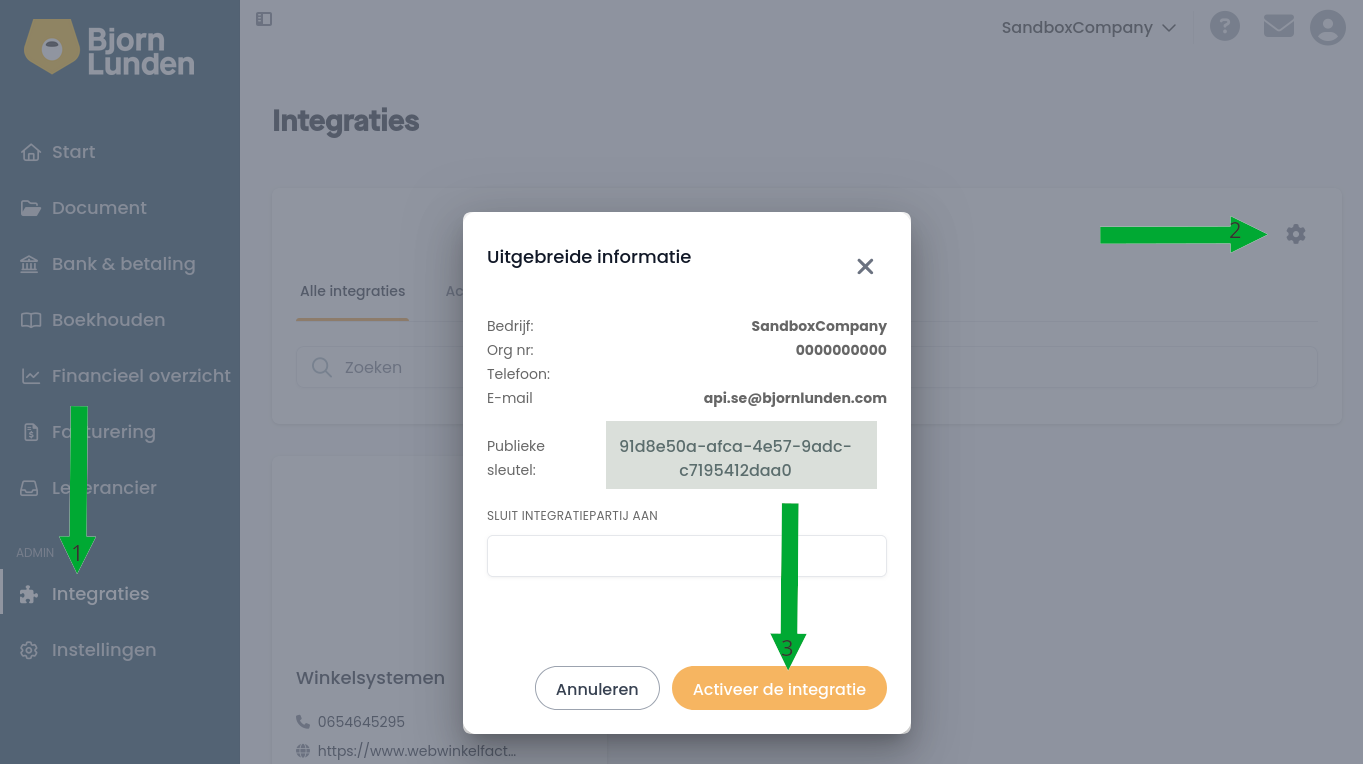
Then you log in on the dashboard https://uwkoppeling.webwinkelfacturen.nl. Enter the key in the Configuration, Authentication, or All Settings tab. This establishes the connection with Lundify.

5.Installation
Installing the integration starts with signing up for a trial period, via our integrations page. After registering, you'll receive an email with an installation URL and login details. Use this installation URL to start the integration installation.
Activating the integration consists of three steps:
1. Establishing the connection with the OpenCart webshop. Through this step, you authorize the integration to read the data from your webshop.
2. Establishing the connection with Lundify. This authorizes the integration to write transactions to your Lundify administration and read information.
3. Configuring additional data, such as the VAT settings.

Authentication with your OpenCart webshop is done via the API key you created in a previous section. Click the red Connect button next to OpenCart and enter the API key in the popup window. If the connection is correctly established, the indicator will turn green. If the connection is not established, check that the API key has a maximum length of 64 and that the license key was not accidentally entered.

Authentication Lundify
Establishing the connection with Lundify is done via the red Connect button in the Configuration tab. In the pop-up, you enter your Customer Code (this is the Lundify online 5-digit member number), and the token you created in the previous section. Please note, you need the entire code as a token, including the 1-part.
To use Lundify, select an administration within your account. You also indicate in which journal the revenue should be posted and what the debtors account is. The journal for processing (individual) orders will be a Sales journal.

When configuring the VAT rates and general ledger accounts, a link is created between the VAT rates in webshop and the VAT codes and revenue accounts in Lundify. You can always make changes by clicking the blue 'Edit' button and selecting an option from the drop-down menus.
By default, all EU countries are shown in the list. You only need to configure the countries you sell to, and - if applicable - ICP and International.
The integration shows the standard VAT rates for Europe. You can adjust the VAT percentage with which you sell - left column. For example: By default, sales to Germany are set to 21%, but if you sell in the webshop with 19%, you can adjust that in the left column. Intra-Community (ICP) and international deliveries
The Intra-Community supplies / ICP option is intended for business-to-business deliveries within the EU. These sales are invoiced with 0% VAT. A VAT number from the customer is required. The International option applies to deliveries outside the EU. For these sales, the integration expects 0% VAT; otherwise, the sales cannot be processed. Separate VAT codes and general ledger accounts can be configured for both ICP and international deliveries.
Once the VAT settings have been configured and saved, you will always see the selected VAT rates. If you want to start over, you can use the grey 'Remove VAT settings' button. Your current settings will then be deleted and you can begin again.

You can create a link here between the payment methods in the webshop and a fixed debtor in your Lundify administration. Orders with a payment method from the list will then always be posted to this debtor. In that case, no new debtors will be created.
Note: It is not possible to set fixed debtors for ICP orders. For an ICP order, a valid VAT number must be transmitted. Therefore, a debtor will always be created in Lundify for an ICP order.

6.Day-to-day: From OpenCart
In this section, we show how we retrieve the orders from the webshop.
Once an order has been processed, it cannot be processed again. Any order changed in the webshop after it has been processed will not be updated in Lundify.
7.Day-to-day: To Lundify
Creating invoices
The orders from Opencart are imported into Lundify as an invoice. This invoice is also immediately posted as a journal entry. For each order, the VAT and general ledger account are provided as configured during the installation of the integration.
When creating invoices, new debtors may be added to Lundify. By default, no products are added to Lundify, and the text line from the Opencart order appears in the Lundify invoice. It is possible to provide a product code. If you want this, please contact webcare@webwinkelfacturen.nl.
Cost center
It is possible to provide one default cost center to the Lundify invoice. One default cost center is possible per integration. Please contact webcare@webwinkelfacturen.nl stating the license key to make use of this.
When processing customer information, it is first checked whether the customer has been processed before. If so, this Lundify debtor is used as the debtor for the Lundify invoice. If the customer is not yet known, they are added to Lundify. Matching is based on email address. Please note: The integration only creates debtors. The integration does not modify debtors.
When processing to Lundify invoices incl. products, products that are not yet in Lundify will be added. See here for an explanation of how product codes are determined FAQ. The product is assigned the VAT code based on the VAT percentage in the order line and the general ledger account configured in the Configuration tab of the dashboard.
Please note: The integration only creates products. The integration does not modify products.
It is not possible to automatically send the created invoice in Lundify to the customer.
Field-level specification Lundify

| Name | Example | Note |
| Customer ID | 1011 | Debtor identifier in Lundify |
| Invoice date | 2025-06-01 | Sales date Opencart order |
| Expiration date | 2025-06-15 | Standard 14 days, not adjustable |
| Comment | Please leave on the doorstep | Comment Opencart order |
| Name | Sarah de Zwart | Debtor name according to Opencart order |
| info@sponiza.nl | ||
| Address | Stationstraat 12 | |
| Postal code | 1234 AB | |
| City | Amsterdam | |
| Country | NL | |
| Recipient name | Mies Talenberg | |
| Shipping address | Dorpsstraat 152 | |
| Postcode - Shipping address | 2345 AB | |
| City - Shipping address | Heerlen | |
| Country - Shipping address | NL | |
| Invoice lines | ||
| Revenue account | 8000 | |
| Product-identifier | prod123 | Only if processing to products is enabled. |
| Amount | 3 | |
| Unit price excl. VAT | 1.50 | Please note: This is the unit price excl. VAT. |
| Line price incl. VAT | 4.91 | |
| VAT code | 2 | |
| Text | Birthday cake | |
| Name | Example | Note |
| name | Confectioner | Empty if there is no company name |
| street | Stationsweg 12 | Address |
| country | SE / NL | Invoice address country |
| email address | info@sponiza.nl | |
| phone no | 0623138822 | |
| Address details | ||
| entityid | 123 | Identifier Lundify debtor |
| Invoice address details | ||
| Name | Example | Note |
| entityId | prod123 | Identifier product |
| account | 8000 | Revenue account |
| name | Birthday cake | Product name |
| descriptionUK | Birthday cake with whipped cream and orange | Product description |
| Vatcode | 2 | VAT code |
| VAT account | 1500 | VAT account |
| costCenter | 001 | Default cost center |
| Because the prices from Opencart are used, and a product is added once and not modified thereafter, no prices are provided with the product. | ||
8.Support
Read more Support .... Read less Support ....
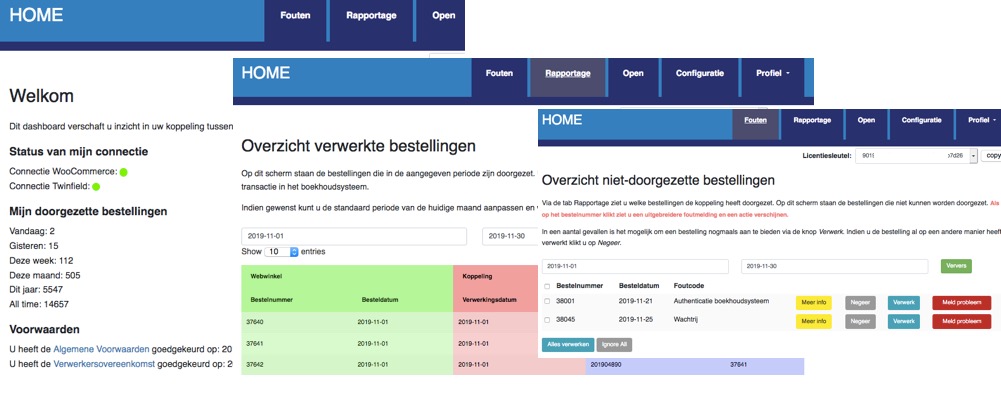
Explanation tabs dashboard
On the Dashboard >> Report you can see which orders from your Opencart webshop, and when, have been transferred to Lundify.What if orders are missing in Lundify
If orders are missing in Lundify we recommend following the steps below:- Log in to the dashboard: https://uwkoppeling.webwinkelfacturen.nl. The username and password are included in the registration email.
- Go to the Errors tab and check if order is there. You may need to adjust the search period if the
order is from a previous month. If you find order in this overview:
- Check the error code and verify whether you can resolve it yourself.
- If yes resolve the issue and click the blue Process button to resubmit the order.
- If not use the red Report problem button to create a ticket with us.
- Note if there are multiple errors, please create only 1 or 2 tickets. We will automatically see the other issues.
- Go to the Report tab and see if order is listed there. If so, you'll often see an identifier for Lundify (in the purple section of the overview) that you can use to search for order.
- Go to the Open tab and check if order is there.
- If you cannot resolve the issue, you can always create a ticket via the green Ask us button.