1.Introduction
This is the manual for the integration between Shopify and Factuursturen.
Are you using the Shopify POS then the sales from this POS of one day can be placed as one daily invoice in Factuursturen. This option can be requested via webcare@webwinkelfacturen.nl. Additional costs are associated with this option.
- This integration is a financial integration. It is not a logistics integration. The integration is not suitable for updating customers in Factuursturen, printing packing slips, or synchronizing products/inventory. The integration works only with the payment status in the Shopify order, where you can configure which statuses should trigger forwarding the order (for example 'processing', 'paid' / 'refund'; multiple statuses are possible).
- An order is forwarded to Factuursturen only once. Changes made after the order has been forwarded will not be applied in the accounting system. Any adjustments must therefore be handled via the refund process in Shopify or updated manually in Factuursturen.
- This integration does not replace the work of an accountant. It saves time because you no longer have to retype documents. The accountant is still needed for advice, expertise, and control.
- Tip: Other customers using this integration found the tips in the FAQ for Shopify and in the FAQ for Factuursturen.
You install this integration from the Shopify App store. If you search for webwinkelfacturen, our apps will appear automatically. You can recognize us as a supplier by the blue gear icon. If you click on the App, you will see a description and the Add app button. Upon activation, you will be automatically guided through the configuration screens.
When you click the Add app button, you must first authorize the integration to read and possibly even write data from your webshop. This is indicated in the next screen. You also need to approve the monthly fee for the integration. Once you have approved the monthly fee, the connection with Shopify is established and you will be automatically redirected to your personal dashboard.
The installation is complete when both connection dots are green, and the settings in the Configuration tab have been entered and saved.
Important: Once the integration is installed, always log in to the dashboard via https://uwkoppeling.webwinkelfacturen.nl, and not via the appstore
There is a 30-day free trial.
The integration is a real-time integration. Once an order has reached a certain status, it will be processed to your accounting system as quickly as possible.
If you want to install another integration, you can do so in the same way. Make sure you are logged out of the integration dashboard and preferably start the new installation in an incognito browser.
If you want to terminate the integration, you can simply remove the app from the app store in your backend.
Are you switching to another accounting system and want to create a new integration? You can install the new app from the app store in your backend. Make sure you are logged out of the dashboard of the old integration and preferably start the new installation in an incognito browser.
Are you switching to another webshop system? Via our integrations page you can see whether you install it from the relevant app store, or by means of an installation link.
Has the installation been successful, but do you see in the dashboard of the integration the old license key still present when you click the dropdown arrow next to the key (even though that app/key has been deleted)? If so, please send us an email requesting that the old key be removed.
2.How the integration works
Shopify works with webhooks. We receive a notification whenever a new order is created in your webshop or when an order is changed. If the order order can be processed—this depends on the status—the integration places the order order in the processing queue. Depending on the processing queue's volume, the order will be processed quickly or slightly later. Generally, queues move quickly.
In addition to the webhooks, a sweep is done daily. This means that the integration checks daily whether all webhooks have been received correctly. If any webhooks are missed, those orders are still retrieved and forwarded.
Read more How the integration works .... Read less How the integration works ....
Note: Foreign orders are never part of the daily invoice. Foreign orders are orders delivered outside the country of the webshop. If a daily invoice is chosen, payments can no longer be processed separately. That option will no longer be available.
At the start of processing an order, we perform a number of checks on the Shopify order:
- It is checked whether the total of the Shopify order is equal to the sum of the amounts in the order lines plus the shipping cost amount.
- If the order is an ICP order, the VAT number is checked.
- It is checked whether a corresponding VAT code exists in Factuursturen for the VAT in each line.
- It is checked whether the order has not already been processed.
Processing a Shopify order to Factuursturen takes place in two steps:
- It is checked if the customer already exists in Factuursturen. If not, the customer is created. Matching is based on the email address.
- The Factuursturen invoice is created and processed.
After the order has been forwarded and a success message from Factuursturen has been received, the order is marked as handled. The Shopify order appears at the Reporting tab on the dashboard.
If Factuursturen returns an error while processing the order, the order appears in the Errors tab on the dashboard. Via the yellow button More info more information about the problem can be found. Via the red button Report problem can the order with all necessary information easily be submitted to us after you have tried to resolve the problem yourself. If the problem is solved, in some cases the orders can be processed again with the blue Process button.
Data
Information about the data that is processed can be found in the section Day-to-day: To Factuursturen later in the manual.
3.Required: Factuursturen key
To connect to Factuursturen, you need a username and an API key. The username is the same one you use to log in. You create the API key within factuursturen.nl. To do this, go to Settings > Connections. There you will see a button to create the API key. Ensure the API key is set to Active and enter a description so you know later what this key is used for.
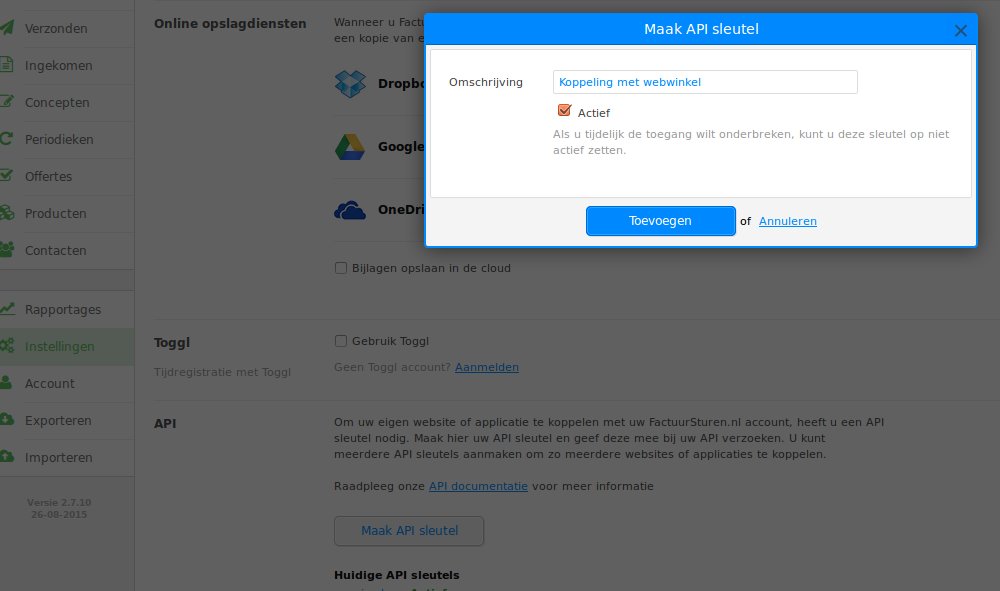
After you click the blue Add button, the new key appears in the Current API keys list.

4.Installation
Activating the integration now continues with:
1. Accepting the terms and conditions.
2. Establishing the connection with Factuursturen. This authorizes the integration to write transactions to your Factuursturen administration and read information.
3. The configuration itself.
Read more Installation ....Read less Installation ....
Before the integration can be used, the terms and conditions must first be accepted. The terms and conditions are based on the general ICT Terms and Conditions (industry organization) and the general GDPR guidelines.

Authentication Factuursturen
You establish the connection with Factuursturen using your username and API key that you determined in the previous step. You click the red Connect button next to Factuursturen. You can enter the username and API key in the popup window.

You can specify which statuses orders should be processed to Factuursturen. You can select multiple statuses. The integration will never forward orders twice. The integration is protected against this.

You can choose an invoice layout for the invoices in Factuursturen.

With Factuursturen, the VAT percentages are used as they appear in the orders. It is not possible to configure separate VAT rates and general ledger accounts.
5.Day-to-day: From Shopify
Once an order has been processed, it cannot be processed again. Any order changed in the webshop after it has been processed will not be updated in Factuursturen.
The integration performs an extra check for orders in the Shopify webshop that are loaded from Bol.com or Amazon. This loading happens via an external app that the Shopify merchant can enable. For these imported orders, the integration performs an extra check whether the VAT is present in the order. If not, the order will not be processed. See our FAQ for more information.
Old orders processing
It is possible to process orders that are already in the Shopify webshop via a migration. You can request this via webcare@webwinkelfacturen.nl. We ask a modest fee for this. We cannot process orders from more than two years ago.
Note: Because the Shopify integration works with webhooks, you should not import orders retroactively in your Shopify webshop after activating the integration. If you do this and for example import 500 orders at once or change the status of 500 orders, our platform will receive all these changes and start processing them. This creates a disproportionate load on our network.
Processing daily revenue
When processing daily revenue, the integration retrieves the receipts from the previous day from the POS system in the morning. The integration combines these receipts into one daily invoice and places it in Factuursturen.
If you want the integration to process refunds in addition to orders, you can enable the status refund or partially_refunded in the Configuration tab under Status process sales. Refunds must be created correctly in Shopify, meaning the refund must be applied to the order lines. Unfortunately the integration cannot process a refund that only contains an amount. For more information see: FAQ.
Please note: For refunds, the integration goes back a maximum of 30 days in time. Also, the integration only processes a refund if the integration has previously processed the order to which the refund relates.
The integration will not read or pass many fields from a Shopify order to Factuursturen. In particular, the note_attribute fields and the custom fields are not included. This is because different webshops use these fields differently. Because our integrations must work for all webshops, we cannot configure this for individual merchants.
Pay special attention to fields that are added via a plugin. There is a significant chance that the integration will not process these fields.
| Below is an elaboration at field level when retrieving orders. The general values in the order and the order rules are discussed, the shipping costs and the debtor details. | ||
| Name field | Values from Shopify order | |
| Order-identifier | [id] | |
| Order number | Is determined as follows:
|
|
| Invoice number | Is determined as follows:
|
|
| Booking date | [created_at] | |
| Order date | [processed_at] | |
| Status order | [financial_status] | |
| Payment status | if the status of the order is paid then paid, otherwise no payment status | |
| Payment reference | [order_number] | |
| Affiliate number | Is determined as follows
|
|
| Valuta | [currency] if present | |
| Payment method | field [gateway] in [transactions] | |
| Order total incl. VAT and discounts | [total_price] | |
| Total VAT order incl. discounts | Value in [total_tax], or, if that value is 0, the value from [current_total_tax]. When using [current_total_tax], there's an additional check. The VAT lines in the order must add up to the value in [current_total_tax]. | |
| Order total excl. VAT and discounts | Difference between the two lines above | |
| ICP indication | The integration determines as follows whether it concerns an ICP order:
|
|
| International indication | The integration determines as follows whether it concerns an international order:
|
|
| Discounts |
Discounts are determined as follows:
|
|
| To read the order lines, the integration retrieves the [line_items] field. Multiple order lines can be included in the order, and the integration reads these lines one by one. | ||
| Name field | Values from Shopify order line | |
| Productid | [product_id] | |
| categoyid | Category associated with the product | |
| Amount | [quantity] | |
| SKU | [sku] | |
| Description | [name] | |
| VAT percentage |
The VAT percentage is determined as follows:
|
|
| Amounts excl. VAT |
The amounts excluding VAT are determined as follows:
|
|
| Amounts incl. VAT |
The amounts including VAT are determined as follows:
|
|
| Discount in order line |
The discount in the order line is determined as follows:
|
|
| VAT code and accounts Factuursturen | These are determined based on the settings, the VAT percentage and the delivery country. This also takes into account whether it is an ICP or international order. When processing by categories, the revenue account of the category is used. This can be set via the dashboard. | |
| To read the shipping costs, the integration uses the field [shipping_lines]. There can be multiple shipping lines. For the name and VAT percentage only the first line is used, while the amounts from all shipping lines are summed. In most cases there will be only one shipping cost line. | ||
| Name field | Values from Shopify order line | |
| Description | [title] from the first shipping cost line | |
| VAT percentage | Sum of the values in field [rate] from the [tax_lines] in the first shipping cost line. | |
| Shipping costs excl VAT |
The shipping costs excluding VAT are determined as follows:
|
|
| Shipping costs incl VAT |
The shipping costs including VAT are determined as follows:
|
|
| VAT code and accounts Factuursturen | These are determined based on the settings, the VAT percentage and the delivery country. It also takes into account whether it is an ICP or international order. | |
| Name field | Values from Shopify customer |
| If present [email] otherwise [contact_email] | |
| Invoice address |
If present based on [billing_address] in the Shopify order
If there is no billing address and no shipping address, the information in [customer] and [customer][default_address] is checked. |
| Shipping address |
If present based on [shipping_address] in the Shopify order
|
| VAT number |
The VAT number is determined as follows:
|
6.Day-to-day: To Factuursturen
Invoices are not automatically sent by Factuursturen. Please contact us if you would like invoices to be sent automatically.
When processing customer information, it is first checked whether the customer has been processed before. If so, this Factuursturen debtor is used as the debtor for the Factuursturen transaction. If the customer is not yet known, they are added to Factuursturen. Matching is based on email address.
Please note: The integration only creates debtors. The integration does not modify debtors.
The integration does not create products in Factuursturen.
The integration creates the invoice in Factuursturen, but will not automatically send the invoice to the debtor. It is possible to set an invoice layout. This can be done via the dashboard https://uwkoppeling.webwinkelfacturen.nl, tab Configuration.
Field-level specification Factuursturen

| Name | Example | Note |
| clientnr | 647 | Factuursturen customer ID |
| action | send | |
| sendmethod | mail - Manual (default), or request email - automatic invoice sending | |
| profile | 1 | |
| sent | 2023-02-13 | order date |
| alreadypaid | full | |
| Paid price | Sales amount if the status is paid | |
| reference | ||
| line1 | order number: 367439 | order number or invoice number |
| line2 | Payment method: Credit card | if name of the payment method is present |
| lines | ||
| Amount | 1 | |
| description | Bed Boxspring | |
| tax_rate | 21.00 | VAT percentage |
| price | 249.00 | Depending on the VAT type of the debtor, the unit price incl. or excl. VAT is used. |
| Name | Example | Note |
| Contact | [firstname][lastname] | |
| showcontact | true | |
| company | [company] | |
| address | [address1] [address2] [house_number] | |
| zipcode | [zipcode] | |
| city | [city] | |
| country | [country] |
If the string length of [country] is equal to 2 or 3, then country = [countryname]. If no country is provided, the default is the Netherlands. |
| phone number | [telnr] | |
| mobile | [mobile] | |
| [email] | ||
| bank code | empty by default. | |
| VAT number | [vatnumber] | |
| tax_shifted | false | |
| sendmethod | [mail] |
If sendinvoice is equal to debtorsend, then sendmethod=[email]. Otherwise always [mail]. |
| paymentmethod | 'bank' | |
| mailintro | Dear [first_name] [last_name] | |
| reference | Thank you for your order | |
| notes_on_invoice | false | |
| tax_type | [extax] | If a priceincltax is passed, then tax_type = [intax], otherwise it is always [extax]. |
7.Support
Read more Support .... Read less Support ....
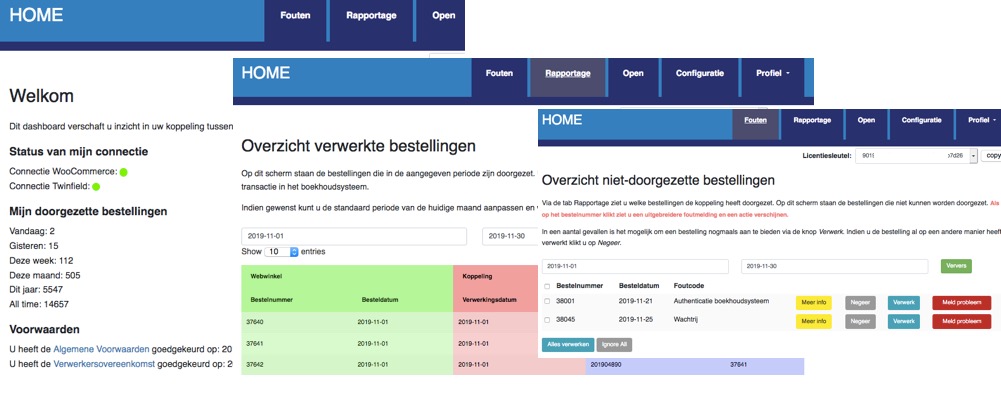
Explanation tabs dashboard
On the Dashboard >> Report you can see which orders from your Shopify webshop, and when, have been transferred to Factuursturen.What if orders are missing in Factuursturen
If orders are missing in Factuursturen we recommend following the steps below:- Log in to the dashboard: https://uwkoppeling.webwinkelfacturen.nl. The username and password are included in the registration email.
- Go to the Errors tab and check if order is there. You may need to adjust the search period if the
order is from a previous month. If you find order in this overview:
- Check the error code and verify whether you can resolve it yourself.
- If yes resolve the issue and click the blue Process button to resubmit the order.
- If not use the red Report problem button to create a ticket with us.
- Note if there are multiple errors, please create only 1 or 2 tickets. We will automatically see the other issues.
- Go to the Report tab and see if order is listed there. If so, you'll often see an identifier for Factuursturen (in the purple section of the overview) that you can use to search for order.
- Go to the Open tab and check if order is there.
- If you cannot resolve the issue, you can always create a ticket via the green Ask us button.